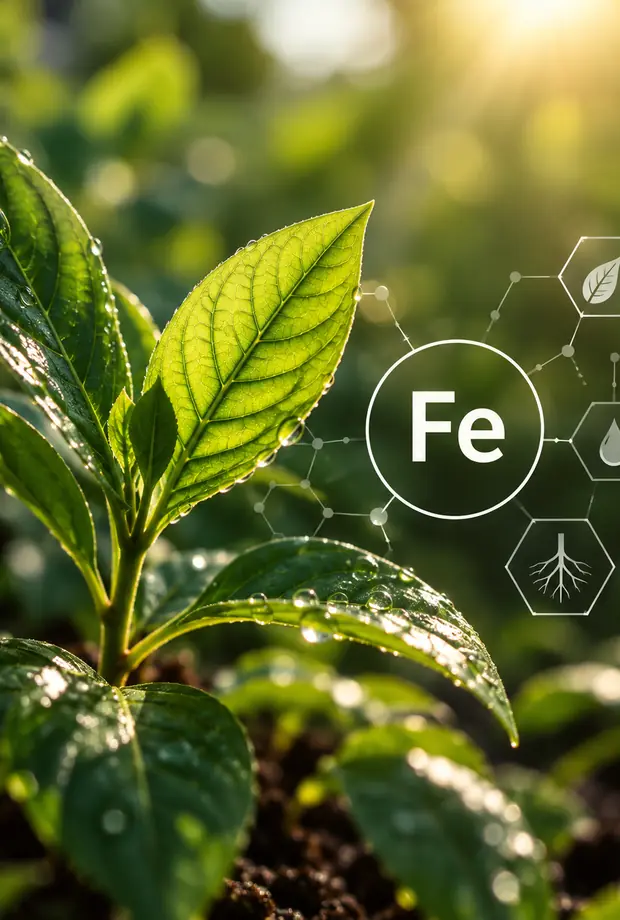
Iron is one of the most abundant elements in the soil and one of the most common deficiencies in the field. That contradiction is the whole story of iron nutrition: the question is never how much iron is present, but how much of it a root can actually take up.
The chemistry of an unavailable nutrient
Plants take up iron mainly as Fe²⁺. In aerated soil, iron oxidises to Fe³⁺ and precipitates as hydroxides and oxides that are effectively insoluble. The higher the pH, the faster this happens — above pH 7.5 the concentration of free iron in the soil solution drops to a level that cannot support a growing crop, and calcareous soils make it worse by buffering the pH exactly where iron is least soluble.
This is why iron chlorosis appears on young leaves while the soil analysis reports plenty of iron. The element is there. It is simply locked in a form the plant cannot use.
What a chelate really is
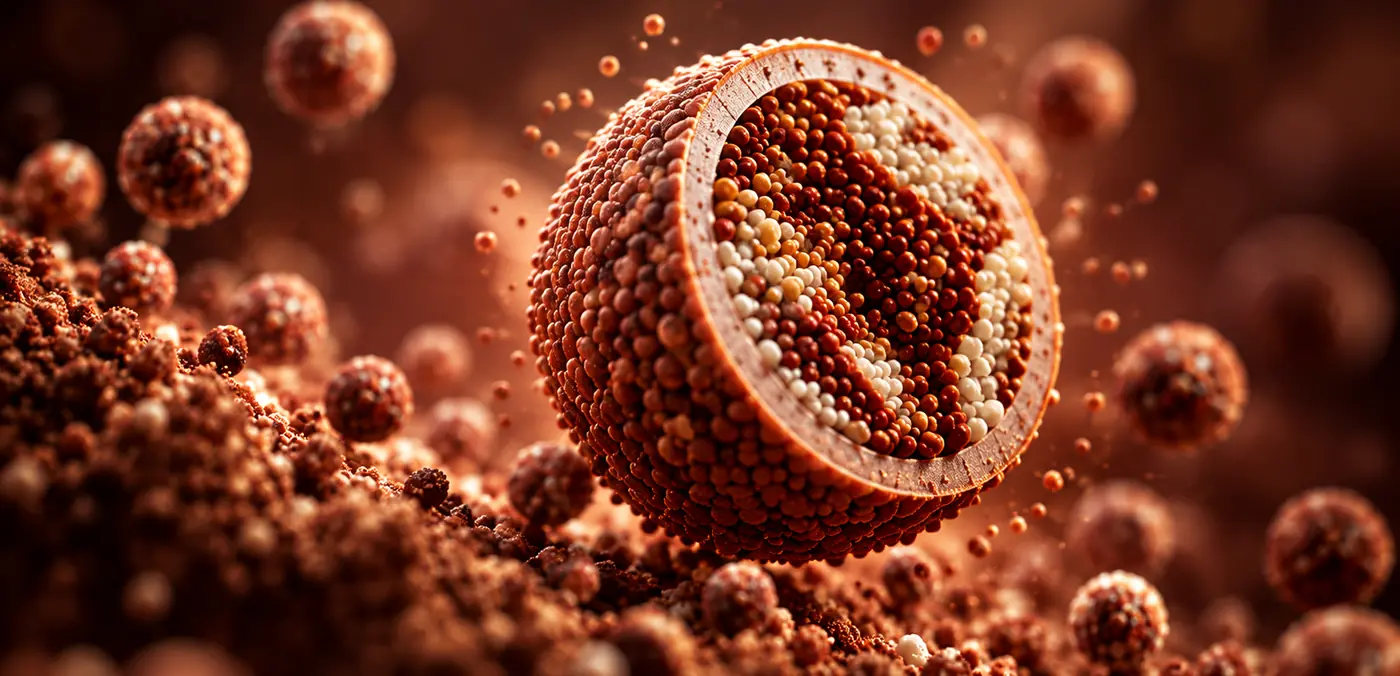
A chelating agent wraps the iron ion in an organic cage, holding it through several bonds at once. Protected in that cage, iron stays in solution instead of precipitating, moves with the water toward the root, and is released at the root surface where the plant can reduce and absorb it.
Not all cages are equally strong. Stability constant describes how tightly the agent holds iron, and pH range describes where that grip survives. EDTA loses iron rapidly above pH 6.5. DTPA extends the range a little. Fe-EDDHA holds iron across the range where high-pH and calcareous soils actually sit, which is why it remains the reference product for correcting chlorosis in those conditions.
A chelate does not add iron to the soil. It keeps the iron that is already there in a form the root can still reach.
Ortho-ortho isomers: the number that matters
Fe-EDDHA is not a single molecule but a family of isomers, and only the ortho-ortho fraction delivers the high stability the product is chosen for. Two materials can both declare 6% chelated iron and behave completely differently in an alkaline soil, because one carries a meaningful ortho-ortho content and the other does not.
- Check the ortho-ortho figure, not only total chelated iron
- Match the chelating agent to your soil pH, not to the price list
- Apply to the root zone with irrigation water for soil correction
- Treat foliar iron as a rescue measure, not as a season-long strategy
Correcting the cause, not the symptom
Chlorosis is a signal that the chemistry of the root zone is working against your crop. Stable chelation is how that signal is answered — a way of keeping iron available through the weeks when the plant is building the leaf area that will carry the whole season.